Talk To Crew Historia: The Youth of Buya Hamka in Makassar
I appeared on Historia.ID to present my research on Buya Hamka's formative years, focusing on his time in Makassar which became the foundation of his intellectual depth and literary masterworks.

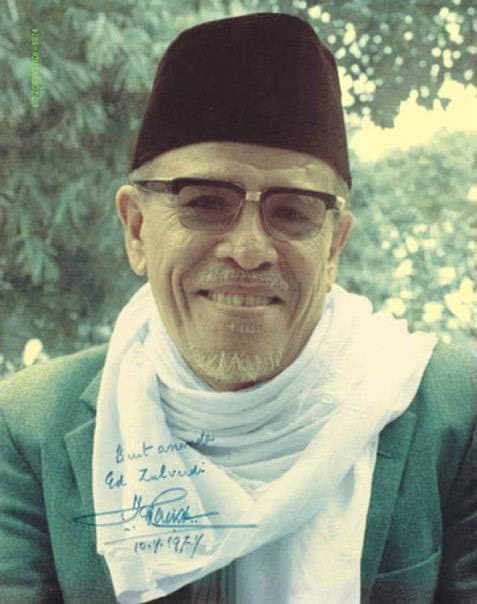
I was invited by Historia.ID to their Talk To Crew program to present the findings of my undergraduate research thesis, which examines a side of Buya Hamka that most biographies barely touch: his formative years and his remarkable years in Makassar.
Minimal Schooling, Towering Intellect
Hamka's formal education did not go beyond elementary school. But the source of his intellectual depth lay in two things: access to his father's library (Haji Rasul was one of Minangkabau's most prominent Islamic scholars) and an insatiable habit of self-directed reading. He absorbed far more from books and from people around him than any classroom could have given him.
Pilgrimage at 17
Hamka left for Mecca at 17, partly driven by family circumstances and the restlessness of his youth. The sea voyage to Jeddah was already an education in itself. He encountered pilgrims from across the archipelago, including people from Makassar and Pekalongan. The rich diversity of characters he met on that ship would later become a deep source of inspiration for his novels.
In Mecca, he found work at a large religious bookshop. The position gave him free access to read extensively and broadened his knowledge far beyond what he could have reached back home.
The encounter that would change his direction happened there. H. Agus Salim gave him a blunt piece of advice: go home. Mecca is for worship, Agus Salim told him, but if Hamka wanted to struggle and truly pursue knowledge in the context of a movement, his place was in the Dutch East Indies. That advice settled it.
A Sharp Young Journalist
Before he was known as a scholar and Quranic commentator, Hamka was a journalist. After returning from Mecca, he settled in Medan and wrote for several newspapers: Pelita Andalas, Seruan Islam, and Bintang Islam. In his teenage years, his writing was already remarkably capable. He engaged in public debates through the press, and notably, every argument he made was grounded in strong written sources and evidence.
Makassar: The Formative Years
This is the heart of my research. Around 1932, Hamka came to Makassar on assignment from the Muhammadiyah central board to help prepare for a congress. He ended up staying for quite some time.
He lived near Jalan Sulawesi, close to Fort Rotterdam, in a lively commercial district. He immersed himself fully in the dynamic character of Makassar's society.
He did not stay in the city. He traveled by bus and boat across most of South Sulawesi for dakwah and organizational work: Bulukumba, Bantaeng, Parepare, Sidrap, Palopo, and even Toraja. One of his greatest achievements was organizing the Muhammadiyah Conference in Palopo, attended by thousands of people who marched through the streets. For a small town at that time, that was extraordinary.
He also helped lay the foundations of modern Islamic education in the region, including establishing the Muallimin Muhammadiyah school in Makassar.
Makassar in His Literary Work
His years in South Sulawesi left a very visible mark on his writing.
His novel "Di Bawah Lindungan Ka'bah" (In the Shelter of the Ka'bah) was written while he was in Makassar. And in "Tenggelamnya Kapal Van Der Wijck" (Sinking of the Van der Wijck), the protagonist Zainuddin is portrayed as having mixed heritage: a Minangkabau father and a Makassarese mother. That was not coincidence. It was an expression of Hamka's deep emotional and intellectual connection to both cultures that shaped him.
A Complete Package
The discussion concluded that Hamka was a rare gift to the Indonesian nation. In one person, the abilities of a Scholar, Quranic Commentator (the monumental Tafsir Al-Azhar), Philosopher, Historian (his History of the Islamic Ummah runs to thousands of pages), pioneering Novelist, and skilled Journalist were all combined. His adventurous youth, especially his formative years in Makassar, was the key that shaped the depth of his thinking for the rest of his life.