Revisiting the Role of Arung Palakka
The story of Arung Palakka, the VOC, and the Treaty of Bungaya that ended Gowa-Tallo's reign as the greatest power in eastern Indonesia.

This article was originally published in Historia magazine on December 31, 2017. Historia is an Indonesian history magazine known for its narrative and in-depth approach to historical storytelling.
In this month of December, 350 years ago, a tense atmosphere still engulfed the hearts of everyone at Fort Somba Opu. A treaty of immense importance to the Kingdom of Gowa-Tallo had just been signed a month earlier, on November 18, 1667. The treaty, known as the Treaty of Bungaya, was reluctantly agreed to by the Kingdom of Gowa-Tallo after half a century of conflict with the VOC (Vereenigde Oostindische Compagnie).
Since the first half of the 17th century, various resistances launched by the Kingdom of Gowa-Tallo in the Maluku Islands were considered a serious threat. At that time, the Company employed various means to consolidate its trade monopoly in the eastern part of the archipelago. Observing the numerous palili' (vassal territories/kingdoms) under Gowa, and considering the heated political climate between the palili' and Sultan Hasanuddin as King of Gowa, the Company finally found an opening by forging an unexpected coalition with Arung Palakka, a brilliant nobleman from Bone who had been brought to Gowa as a captive in late 1644.
Although Arung Palakka had once served Karaeng Pattingngalloang, the Tuma'bicara Butta (Prime Minister) of the Kingdom of Gowa-Tallo, Gowa's dominion and tyranny over Bone was a matter of siri' (honor and dignity) for him. Sometime between June and August 1660, Arung Palakka, Arung Kaju, Arung Maruangeng, and Daeng Pabila, aided by Tobala' -- the latter being a regent of Bone appointed by Gowa -- decided to flee and return to their homeland. This occurred after Karaeng Karunrung ordered 10,000 Bugis people of Bone to dig a canal near Fort Panakkukang, which had been captured by the Company.
The flight quickly gave rise to an alliance, with an invitation extended to the Kingdom of Soppeng to join forces with Bone. Despite opposition from some Soppeng nobles, the alliance was eventually formed through the Pincara Lopie ri Attapang (Treaty of the Raft at Attapang). The Kingdom of Wajo, another palili' of Gowa invited by Arung Palakka to join the alliance, refused. Although the alliance was subsequently defeated in several battles against Gowa -- forcing Arung Palakka to flee to Buton and then Batavia (Jakarta) -- slowly but surely, a flame had been lit on the fuse that would destroy Gowa and compel it to sign the Treaty of Bungaya six years later.
Arung Palakka Returns
After moving from Buton to Batavia with the Company's assistance, Arung Palakka was asked to suppress a Minangkabau rebellion on the west coast of Sumatra. Arung Palakka agreed and set out with the Toangke, a name given to approximately 400 Bugis people who had been living with him near the Angke River. On August 30, 1666, he arrived in Padang together with Captain Joncker, who commanded the Ambonese troops. This was a proving ground for Arung Palakka to further convince the Company of his reliability. Victory was achieved, and he was even bestowed the title "King of Ulakan" by the people of Ulakan for his bravery there. The Company's conviction that Arung Palakka might be the key to defeating their enemy in the east -- Gowa -- was further strengthened when Arung Palakka defeated Acehnese forces at Pariaman.
Not long afterward, the Council of the Indies in Batavia issued a resolution on November 2, 1666, to dispatch an expedition to Makassar and the eastern regions with the purpose of "declaring war on the Makassarese." Nevertheless, the Company still hoped the matter with Gowa could be resolved peacefully. The Company was well aware that Gowa was the greatest kingdom in the eastern part of the archipelago. Throughout half a century of confrontation between Gowa and the Company, no significant victory had been achieved by the Company. Waging war against Gowa once more was a shortcut to destruction for the Company and all its interests in the east.
However, the Company ultimately had no choice but to proceed to Gowa, appointing Cornelis Janzoon Speelman, a controversial Company official, to lead the expedition. He departed with the two war leaders who had just succeeded on Sumatra's west coast: Arung Palakka and Captain Joncker. Speelman's primary task was to pursue peace and demand that Gowa apologize, particularly over the killing of Dutchmen on Don Duango Island and the "plundering" of the shipwrecked vessel Leeuwin, while not ruling out war if Gowa refused. The expedition to Makassar led by Speelman set sail on November 24, 1666, carrying twenty ships with 1,870 men.
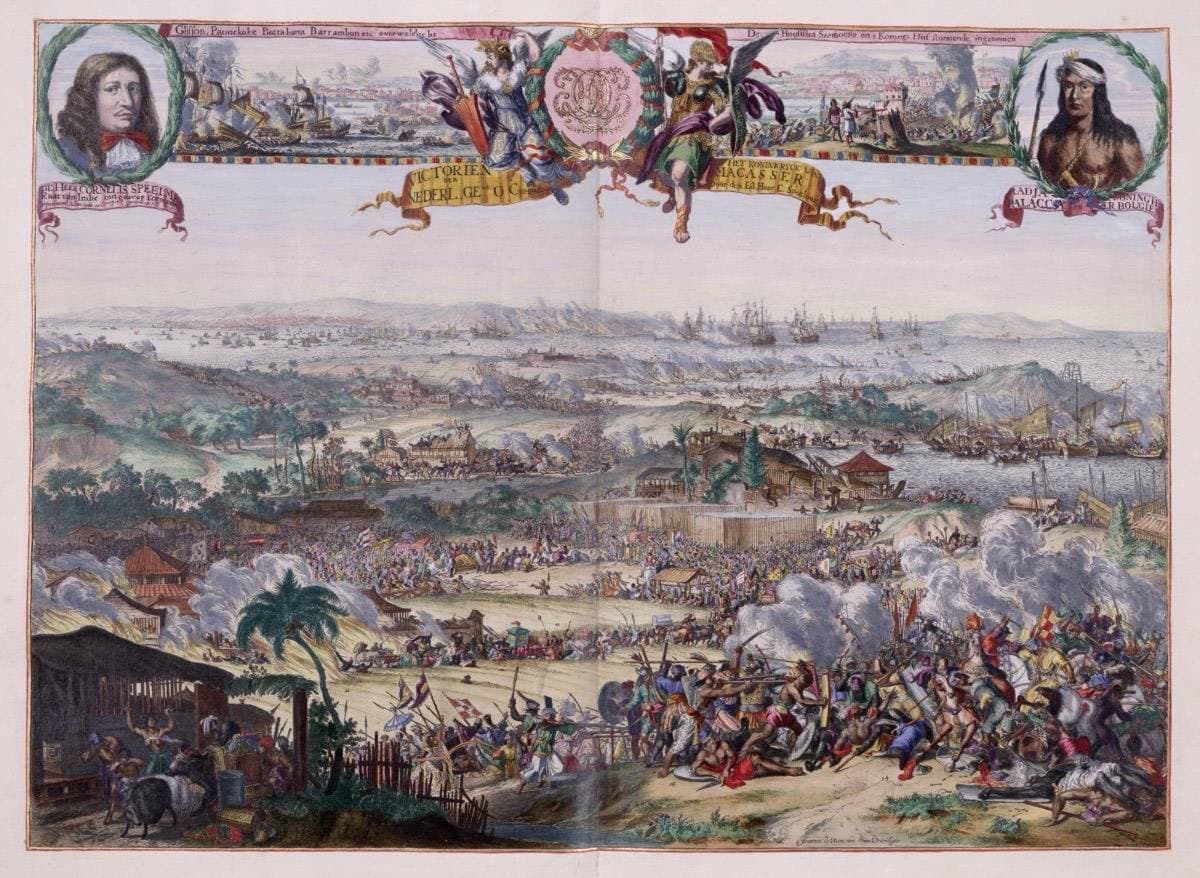
On December 17, 1666, this armada arrived near Tanakeke Island and reached the coast of Makassar two days later. The demands put forward by the Company were met with a visit from two prominent Gowa nobles accompanied by two interpreters, bearing 1,056 gold coins and 1,435 coprijksdaalders as compensation for the Don Duango incident and the Leeuwin. All of these were rejected by Speelman. Two days later, the Dutch envoy returned from Somba Opu, the palace of the Kingdom of Gowa, bearing failure: Sultan Hasanuddin had rejected the Dutch demands. In accordance with instructions from the Council of the Indies and the Governor-General, Speelman moved toward the port of Makassar to within half a kilometer of the shore and began bombarding the area.
This event marked the beginning of the Makassar War. Fierce resistance was mounted by Gowa, which had not anticipated the sudden attack -- not only from the Company's armada attacking from the sea but also from a ground assault by Bugis forces under Arung Palakka's command, striking from the south. The fighting raged for 11 months before both sides finally agreed to a ceasefire. They met on November 13, 1667, to negotiate a peace agreement at Bungaya, a village near Barombong.
The Treaty of Bungaya
The meeting took place on an open field at Bungaya. Key leaders such as Speelman, Arung Palakka, Sultan Hasanuddin, and Karaeng Karunrung were present. Initially they communicated through interpreters, but as this method was deemed ineffective, Karaeng Karunrung -- the most linguistically skilled among them -- became Gowa's chief negotiator. The negotiations between Speelman and Karaeng Karunrung were conducted in Portuguese. The result of these negotiations, which could not be completed in a single day, became known as the Treaty of Bungaya.
The Treaty of Bungaya completely altered the course of history in South Sulawesi. Comprising 26 articles plus three supplementary articles, this treaty not only marked the fall of the Kingdom of Gowa but also signaled the beginning of full Company dominance in the eastern part of the archipelago. Four months earlier, the conclusion of the Second Anglo-Dutch War had given the Dutch Pulau Run, the primary nutmeg-producing island in the Banda archipelago, in exchange for New Amsterdam, which would later become New York.
The Treaty of Bungaya also inflicted enormous losses on other international merchant groups who had long traded at Somba Opu, particularly the English. The treaty decreed that all European traders (except the Dutch), as well as Indian/Moorish, Javanese, Malay, Acehnese, and Siamese merchants, were prohibited from trading in Makassar. The day after the Treaty of Bungaya's terms were finally agreed upon on November 18, 1667, merchants of various nations, especially English and Portuguese, began leaving Somba Opu. Two days later, Speelman entered Fort Jumpandang, which would later be renamed Fort Rotterdam.
For the twin kingdoms of Gowa-Tallo themselves, this treaty effectively marked the end of Makassar's glory as the greatest power in the eastern archipelago since the early 17th century. The Treaty of Bungaya required that all fortifications belonging to the kingdom, except Somba Opu and Jumpandang, be destroyed. On June 24, 1669, Somba Opu, which housed the palace of the Kingdom of Gowa, also fell following a subsequent war initiated by Karaeng Karunrung after the Treaty of Bungaya.
Thus all the fortifications of the Kingdom of Gowa-Tallo fell under Company control. The Company used this reality to reinforce the terms of the Treaty of Bungaya that had been agreed upon two years earlier. On July 15, 1669, representatives of Tallo came to Fort Rotterdam to reaffirm the treaty, followed by representatives of Gowa on July 27, 1669. They laid down their weapons and swore upon the Quran, drank water, and unsheathed their kris daggers to reaffirm the treaty.
Paradoxes
Arung Palakka did not need long to become the new leader of Sulawesi and the entire eastern archipelago. Speelman occupied Fort Rotterdam and made it the Company's office and his personal residence. Arung Palakka, meanwhile, resided at the Bontoala palace, approximately two kilometers from Fort Rotterdam. Several years later, both men reached the pinnacle of their careers: Speelman was appointed Governor-General of the VOC in 1680, while Arung Palakka was appointed King of the Kingdom of Bone in 1672.
Throughout the events of the 17th century in South Sulawesi, many paradoxes can be found that sometimes bewilder readers of history. These arise from a combination of traits and characteristics of the Makassarese and Bugis people -- for instance, a love of knowledge, tolerance of differences, and a desire for freedom and independence -- alongside political ambitions that necessitated conflict, war, or even the subjugation of one's own kin.
History records that the Kingdom of Gowa-Tallo, before its defeat, was remarkably open to other nations. Dozens of trading offices from various nations existed at Somba Opu. Likewise, places of worship belonging to European nations were freely established with the permission of Gowa's rulers. This demonstrated a love of knowledge and tolerance of differences. Yet at the same time, Karaeng Karunrung's order for 10,000 Bugis people of Bone to perform forced labor digging a canal near Fort Panakkukang was paradoxical to that spirit of tolerance. It was this that drove Arung Palakka and several other Bugis nobles to flee Gowa.
The paradoxes in South Sulawesi's history do not end there. Arung Palakka's desire for freedom and independence led him to accept the Company's offer to jointly wage war against Gowa. When the Company and Arung Palakka defeated Gowa, another paradox emerged: the Company's decision to expel the various nations that traded in Makassar. Here, it is no simple matter to separate the traits and character of the Makassarese and Bugis people from their respective political ambitions.
Reflection
The destruction of the Kingdom of Gowa-Tallo resulting from the coalition of the Company and Arung Palakka is often cited by many as proof that the Bugis were friends and servants of the colonizers. It must be acknowledged that some parties wish to perpetually stoke conflict between the Makassarese and Bugis. However, by reading history, we can improve our view of the Bugis -- if you are Makassarese -- and of the Makassarese -- if you are Bugis. The 350 years of history since the signing of the Treaty of Bungaya have proven this.
Arung Palakka died on April 6, 1696, and was buried in Gowa. His tomb now stands in the middle of a settlement whose residents are almost entirely Makassarese. Three centuries have proven that this tomb has been well cared for by the very people he once conquered. After his death, the Aruppitu (Bone's Customary Council) independently chose Arung Palakka's successor, La Patau Matanna Tikka, and promptly went to Rotterdam to report the decision. Van Thije, the Company's representative there, welcomed them and informed them that the decision would be sent to Batavia for approval by the Council of the Indies. The Aruppitu stood firm, and their spokesperson declared: "We did not come here to discuss the election. We came here to inform you of what we have decided."