Muhammadiyah Studies Talk #5: National Book Day and the Literacy Tradition of Muhammadiyah
I served as moderator for this forum discussing Indonesia's national literacy landscape and a book review of 'Covering Muhammadiyah', organized by MPI PWM South Sulawesi.

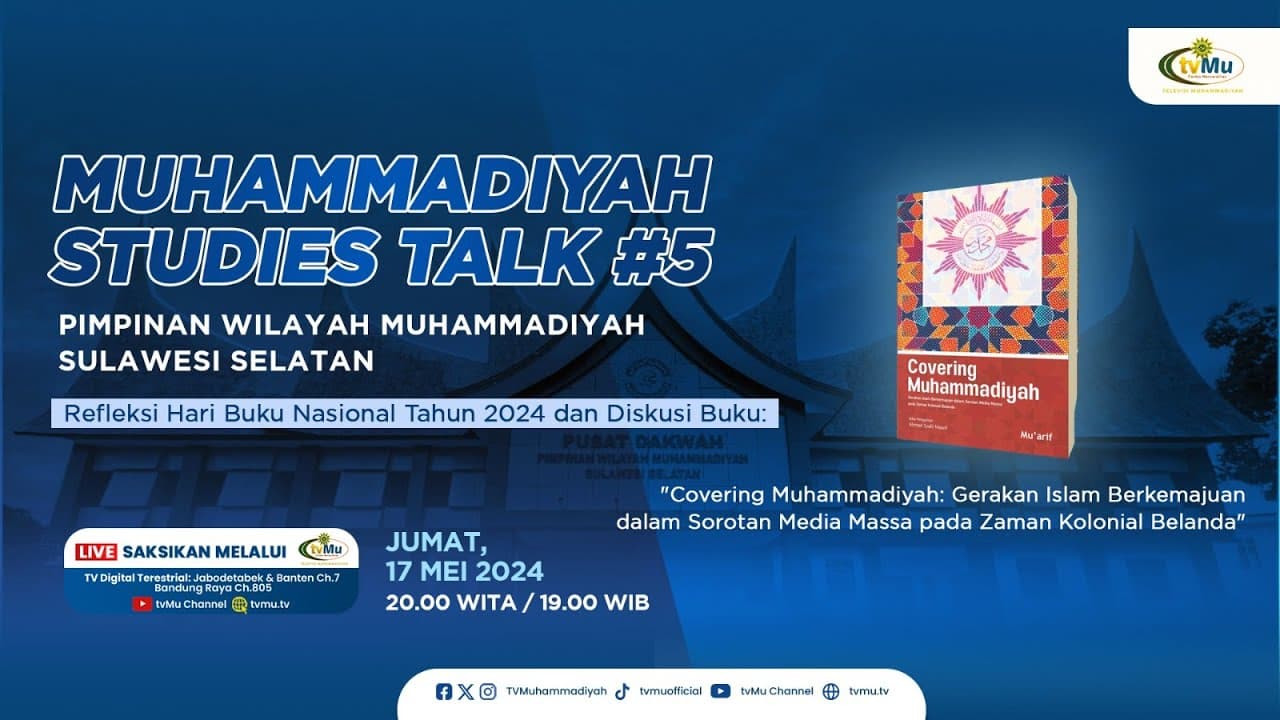
On May 18, 2024, I served as moderator for Muhammadiyah Studies Talk #5, organized by the Council for Libraries and Information (MPI) of the Muhammadiyah Regional Board of South Sulawesi, where I also serve as a council member. The event was livestreamed on the tvMu Channel in observance of Indonesia's National Book Day 2024.
The two-hour forum was structured around two main sessions: a keynote on Indonesia's national literacy condition and a review of a book on the history of Muhammadiyah's press.
Keynote: The State of National Literacy
Prof. Aminuddin Aziz, Head of the National Library of Indonesia, opened with a finding that challenges a common assumption. The idea that Indonesians have low reading interest is simply not accurate. Surveys show reading interest is actually high. The real problem is availability: one book is shared among eleven people.
He went further to diagnose what he called a "collective sin" within the national book ecosystem. Writers don't research reader demand. Publishers publish without clear purpose. Libraries stock books that have no relevance to local communities. Everyone contributes to the same dysfunction.
On print versus digital, the research is clear: print books significantly outperform devices for memory retention and building a love of reading. As a response to the access crisis, the National Library launched a program placing 10,000 reading spaces across villages, each stocked with 1,000 quality books at no cost, and allowing Village Funds to be used for library operations.
Book Review: Covering Muhammadiyah
Muarif presented findings from his book examining how colonial-era media covered the Muhammadiyah movement. The archival material revealed a surprisingly active and sophisticated press culture.
Muhammadiyah had an extensive colonial-era press. From its early years, the organization already operated around 94 print publications, including Suara Muhammadiyah, Medan Muslimin, and Bintang Islam.
Journalists used clever pseudonyms to evade Dutch censorship. "Idagnas" was "Sangadi" spelled backwards. "Namidramos" reversed to "Sumardiman". These were deliberate strategies to continue writing without triggering press violations under colonial law.
An elegant response to blasphemy. When a Solo newspaper called Jawihisworo insulted the Prophet Muhammad, Muhammadiyah leaders did not respond with anger or mass mobilization. Instead, they pursued legal channels and wrote directly to the Governor-General of the Dutch East Indies.
Early advocates for hajj reform. As far back as 1920, Muhammadiyah was the driving force behind forming a committee to improve the hajj pilgrimage process for Indonesians, which at the time was badly mismanaged.
"Indonesia" before the Youth Pledge. Three years before the 1928 Youth Pledge, the cover of Suara Muhammadiyah in 1925 had already deliberately used the word "Indonesia".
KH Ahmad Dahlan was also a writer. Archives show the founder of Muhammadiyah was actively writing in Medan Muslimin and Suara Muhammadiyah under initials like "Adil" or "Khatib Amin Jogja". He was not merely a man of action.
Reflections from the Discussants
Dr. Dahlan Lamabawa and Dr. Fadli added important context: Suara Muhammadiyah surviving across three distinct eras of Indonesian history (colonial, New Order, and the digital age) is concrete proof of how deeply literacy runs in Muhammadiyah's institutional DNA.
What struck me most: KH Ahmad Dahlan founded Muhammadiyah in 1912 partly because he was inspired by reading the magazine Al-Munir from Padang Panjang starting in 1911. The organization itself was born from reading.
Literacy for Muhammadiyah is not a program. It is one of the four pillars of "Progressive Islam" that the organization has practiced for over a century.