First Touch of Montmartre
A first experience in Montmartre, Paris - from the beauty of Sacre Coeur to valuable lessons about education and a Muslim's responsibility.

Friday, October 25, 2013
The Airbus 340-600 that carried me from Doha, Qatar, finally landed perfectly at Charles de Gaulle Airport (CDG). This airport is the main airport in Paris, although it actually mostly serves flights for international routes. I first set foot on French soil when the clock showed 8:12 AM, and it was still very dark outside, exactly like 3:00 AM in Makassar.
After leaving the baggage claim at CDG, I took the elevator up to the airport shuttle bus heading to Terminal 3. From Terminal 3, you can purchase a ticket to Gare du Nord station, the main and largest station in Paris. A ticket priced at 9.7 Euros for the RER B directly to Gare du Nord was secured, and since I was confused about whether anyone from the PPI France committee would be picking me up at the airport, I ultimately decided to head on my own to Le Village, a hostel in the Montmartre area that I had booked on hostelworld.com. I chose to stay at Le Village because of its fairly good rating on this website recommended by backpackers everywhere. Not a promotion, mind you.
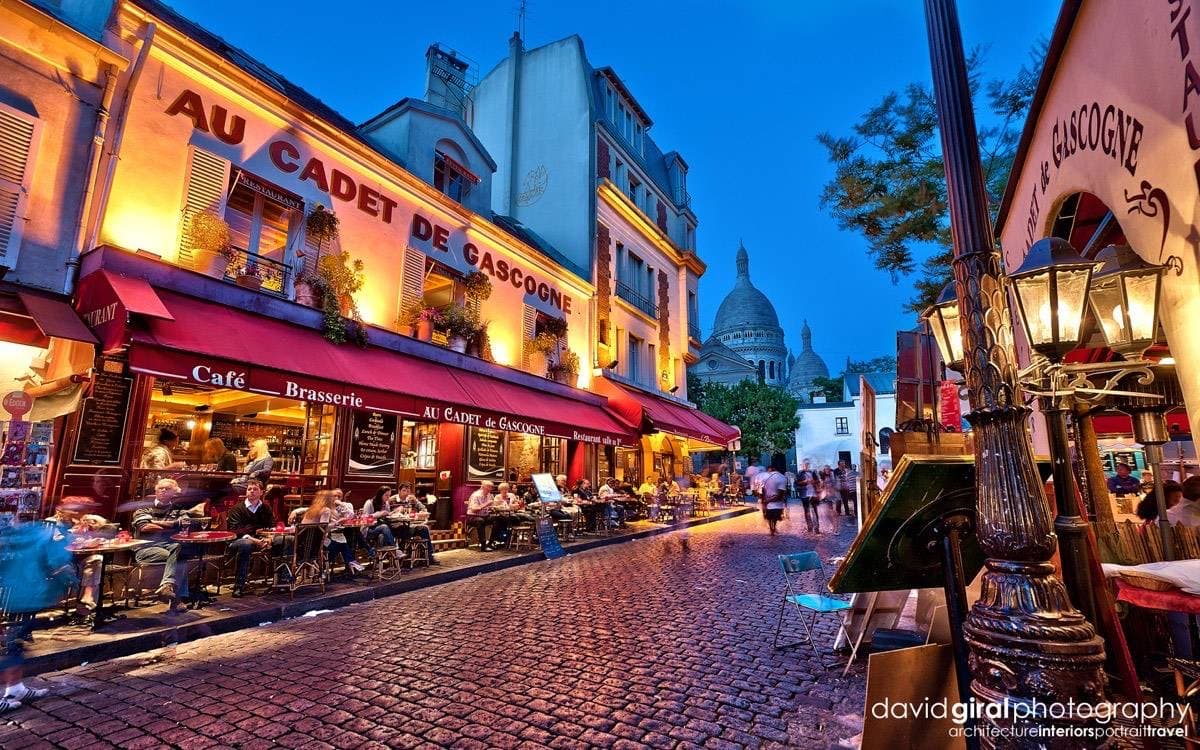
Montmartre is the place where world-renowned artists such as Van Gogh, Picasso, Monet, and others once lived and created their masterpieces. In Montmartre, there is also a grand basilica called Sacre Coeur. But what I want to share here are the impressions and feelings I experienced during my first days in Montmartre.
First Day in Montmartre
My first day in Montmartre was an exhausting Thursday after spending roughly 23 hours traveling from Jakarta to Montmartre. After arriving at Gare du Nord station, I activated the WiFi and opened Google Maps. It turned out I had to walk to the right after getting off the RER B, continue until reaching ground level again, and find La Chapelle station. From La Chapelle, I asked a young French person -- who thankfully was willing to respond in English -- about what Anvers station looked like. After being shown the way, the metro arrived and I, while dragging my suitcase, boarded the metro heading to Anvers. Upon reaching Anvers and getting to the surface, I looked to my right and saw Sacre Coeur standing there, on top of the hill -- this basilica was truly enormous.
Not wanting to linger, I walked forward two blocks and turned right one block before Sacre Coeur -- this is where Le Village was located. Long story short, I checked in and slept until the afternoon.
A Scam in the Name of African Children
At 4:00 PM, I woke up. After freshening up and praying, I tried to explore the Montmartre area starting from Rue d'Orsel where my hostel was located. There were a great many souvenir shops in the area, fully stocked. I took the initiative to visit the legendary Sacre Coeur. From a distance, I could see many dark-skinned men on the stairs leading up to Sacre Coeur. But without paying much attention, I kept holding my camcorder while continuing to walk up to Sacre Coeur. In the middle of happily reviewing my Doha footage, my left hand was suddenly grabbed by a dark-skinned man around 25 years old, who then fastened a bracelet made of cheap string -- the kind used to tie rice sacks -- around my wrist. He then said, "Sincerity for African Children, sir." In that moment, I realized I had been caught in a scam!
I argued with this man for a long time, and his other dark-skinned, large-bodied companions had already surrounded me. I thought this was going to become a complicated problem. Despite being from Makassar, I have never in my life been one for violence. Especially after this man demanded 100 euros for that one cheap bracelet. But then it crossed my mind that these people must be from Senegal or thereabouts, and they could probably speak Arabic. So I took the initiative to say, "Ana Indonesi" (I am Indonesian). They responded and immediately asked whether I was Muslim or Christian, and I spontaneously replied that I was a Muslim.
I then offered some advice that was at least somewhat useful to me, and hopefully to them as well. Why earn a living in such a dishonest way? Do you not feel you are violating others' rights by forcing them to spend tens or even up to 100 euros in the name of African children?
Hearing that, they actually argued back, saying "Don't lecture us too much" and "Respect the culture here!" But since I had spent too long in this debate that I did not enjoy, I pulled out 20 euros and held it up to them, adding a parting message: "Stop making money in the name of African children!" It was nearly five o'clock when I walked away in frustration.
Africa, Muslims, Education, and the Lesson Learned
In the days that followed, as my friends and I explored Paris using the underground metro, I discovered many truths I had not known before. In many metro stations and on the walkways to the surface, I saw beggars wearing headscarves. Whether they were actually Muslim women, I could not say. But from my experience of being scammed by the Africans on the stairs of Sacre Coeur, I took away a valuable lesson that further strengthened my conviction that "You will never be a good Muslim unless you are knowledgeable," as Imam Shamsi Ali once said.
What I saw at Sacre Coeur and in the metro stations of Paris truly awakened me to the reality that the Islamic world, once glorious and the center of world civilization, has now become ailing in the very places that once learned from it. All because of one primary cause: the abandonment of knowledge as the lifeblood of society in the Islamic world. The Africans who scammed me at Sacre Coeur, the beggars in the metro stations of Paris -- they are proof of all this. They are a group of unfortunate Muslims who were perhaps never touched by education, now serving as living evidence of this decline. Because they were never reached by education back in Africa, they came to France seeking work. But when no decent job would accept them with such educational qualifications, the shortcuts like what I witnessed become the path they take.
My first touch of Montmartre became a crystal-clear sign to me that every Muslim bears responsibility to their faith. Do not bring shame upon your community, your religion, your nation, and your country through actions born of ignorance. My first touch of Montmartre guided me: never be lazy in learning, for the dignity of your community, your religion, your nation, and your country rests in your hands. I was reminded of Bung Hatta's words when he read his defense statement at the Dutch Court, while campaigning for Indonesian independence:
Only one thing can be called "my homeland." It is born from action, and that action is my own!