Selawat for the New Order
My opinion piece on IndoProgress about the irony of conservative Islamic populism embracing the Suharto legacy, and the history of Selawat Asyghil as a prayer of Muslim resistance against authoritarian rule.

This article was originally published in IndoProgress on April 7, 2017. IndoProgress is an independent, non-profit Indonesian online media outlet known as a space for critical discourse on politics, society, and culture. I wrote this piece in Makassar in March 2017, while studying History at Universitas Hasanuddin, where I had also served as Chairman of KAMMI (the campus Islamic student organization).
If you want to see how weak the position of Muslims is in Indonesia, now is perhaps the right time. Amid the global rise of conservative populism, it appears that some Islamic movements in Indonesia have joined the trend. Without realizing it, they have willingly joined the ranks of the same brand of conservative populism promoted by Donald Trump and white conservatives in the United States, Marine Le Pen in France, Brexit in the United Kingdom, the PEGIDA movement in Germany, and politician Geert Wilders in the Netherlands. Worse still, the rise of conservative populism in Indonesia has been led by figures known as leaders of relatively "hardline" Islamic organizations, such as Habib Muhammad Rizieq Shihab of the Islamic Defenders Front (FPI), among other Islamic figures seen in the populist "411" and "212" rallies.
At the same time, true to its nature, Indonesian Muslims seem highly attracted to the rhetoric of this conservative populism. Much of that rhetoric, when examined deeply from both secular and Islamic perspectives (especially maqashid syari'ah), does not truly address the fundamental problems faced by Muslims and Indonesian society at large. To be honest, many of the ideas and rhetoric that have been developed over the past year, particularly visible in the "411" and "212" rallies, carry more of a political flavor, sometimes seasoned with racism and ethnic sentiment, although of course not all of it is like that.
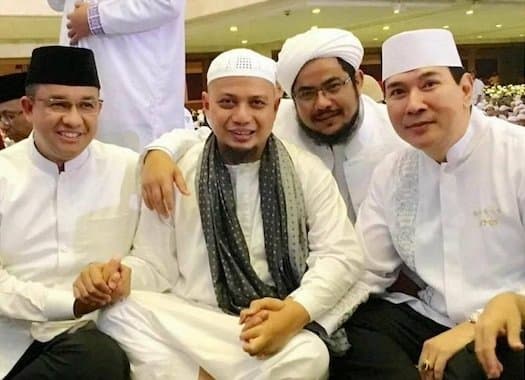
What is even more saddening is the Suharto family's alignment with conservative populism, which appears to have occurred with almost no resistance from Muslims. This was evident in the "Shalawat Untuk Negeri" (Prayers for the Nation) event held at Masjid At-Tien in Taman Mini Indonesia Indah on Saturday, March 11, 2017, which also commemorated the anniversary of Supersemar (the March 11 Executive Order). The event was organized by the family and children of former president Suharto: opened by Titiek Suharto, attended by Tommy Suharto, Mamiek Suharto, Tutut Suharto, and invited figures such as Habib Muhammad Rizieq Shihab (FPI), Prabowo Subianto, Abdullah Gymnastiar, Hidayat Nur Wahid, as well as Jakarta gubernatorial candidates Anies Baswedan, Sandiaga Uno, and Djarot Saiful Hidayat (the latter was subsequently expelled from the venue).
For many people, the event was horrifying. Muhammad Al Fayyadl, a well-known progressive young NU activist, expressed his alarm on social media about the selawat event that simultaneously commemorated the anniversary of Supersemar. islambergerak.com, a progressive Islamic media outlet, issued a kind of fatwa on the ruling regarding idolizing Suharto. The same concern was voiced by a number of progressive Islamic activists.
Above all, this arguably ill-fated event seemed to illustrate the 'amnesia' afflicting Indonesian Muslims. It was as if they had forgotten that one of the greatest victims of New Order policies throughout its 32 years was the Muslim community itself. Terrible events such as the Tanjung Priok Incident (1984), the Talangsari Incident (1989), Military Operations in Aceh (1988-1998), as well as the arrests of Islamic scholars and activists, and the suppression of various Islamic organizations and movements throughout the New Order period.
Selawat Asyghil: A Prayer Against the New Order
It did not take 32 years for Indonesian Muslims to recognize how hostile the New Order was toward Islam. In the early 1970s, a form of selawat emerged containing prayers for Muslims to be protected from the tyranny of those in power, in this case, the New Order. This selawat became known as "selawat asyghil", referring to the word "asyghil" (meaning: occupy/distract them) within its text. It was also known as "selawat betawiyyin" (Betawi Selawat), "selawat mlipir", and "selawat sibuk" (busy selawat).
According to the late KH. Rahmat Abdullah, an important figure in the Jema'ah Tarbiyah movement, in a lecture at Masjid Ukhuwah Islamiyah at the University of Indonesia in the early 2000s, the selawat was first popularized in Indonesia in 1971-1972 through the radio station of Yayasan Perguruan Asy-Syafi'iyah, a respected Islamic institution in Jakarta. This selawat was particularly special because it was chanted in a melodious yet melancholic and sentimental tone.
The selawat was encouraged by the late KH. Abdullah Syafe'i to be recited and chanted in mosques during Maghrib, between the call to prayer and the iqamah. It became popular among Muslims, including Nahdlatul 'Ulama (NU) members and Indonesian Muslims in general during the New Order era. Selawat Asyghil became the ultimate prayer of Muslims seeking God's protection from the tyranny of the New Order. During various political campaigns of the United Development Party (PPP; regarded as the voice of Muslims at that time) in the New Order era, Selawat Asyghil was frequently chanted.
The text of Selawat Asyghil:
اللَّهُمَّ صَلِّ عَلَي سَيِّدِنَا مُحَمَّدٍ وَأَشْغِلِ الظَّالِمِيْنَ بِالظَّالِمِيْنَ وَأَخْرِجْنَا مِنْ بَيْنِهِمْ سَالِمِيْنَ وَعَلَي الِهِ وَصَحْبِهِ أَجْمَعِيْنَ
Allahumma sholli 'ala sayyidina Muhammad wa asyghilidz dzolimin bidz dzolimin wa akhrijna min bainihim salimin wa 'ala alihi wa shohbihi ajma'in.
Translation: "O Allah, bestow blessings upon our leader Prophet Muhammad, and occupy the oppressors with one another. Deliver us safely from their midst. And bestow blessings upon all his family and companions."
It is not entirely clear who composed this selawat or when. In some readings, many scholars attribute it to Habib Ahmad bin Umar Al Hinduan (d. 1122 H) because the verses of this selawat are found in the book Al Kawakib Al Mudhi'ah, a collection of selawat verses by that scholar. However, in that book, he merely included it rather than claiming authorship. Other sources suggest that this selawat was practiced and most likely composed by Jafar Al Shadiq (d. 138 H), a sixth-generation descendant of the Prophet Muhammad. He was an Islamic intellectual who lived during the tumultuous transition between the Umayyad and Abbasid Dynasties. He chanted this selawat so that those engaged in conflict and tyranny would be occupied with each other, leaving scholars free to pursue knowledge undisturbed. Let the power-seekers fight amongst themselves, while scholars and intellectuals continue their study and pursuit of knowledge.
A deeper investigation into the history of Selawat Asyghil is needed, but what matters most for Muslims today is to understand the historical context of its emergence in Indonesia. Selawat Asyghil, which was originally broadcast on the radio of the Asy-Syafi'iyah institution founded by the late KH. Abdullah Syafi'i, was offered as a prayer against the tyranny of the New Order regime. It is therefore deeply ironic that in the reform era, Islamic leaders walk alongside the Suharto family and cronies, the very symbols of New Order tyranny. Muslims must rise to take a more dignified position than the one they occupy now. The various Islamic organizations and movements that are free to operate and preach in the Reform Era must never forget how their organizations and movements were oppressed, persecuted, and forced into silence for 32 years of New Order rule.
This article was originally published in IndoProgress on April 7, 2017.