My Impressions and Encounters with Hamka and TKVDW
A personal account of encounters with the works of Buya Hamka and a review of the film Tenggelamnya Kapal Van der Wijck (The Sinking of the Van der Wijck).

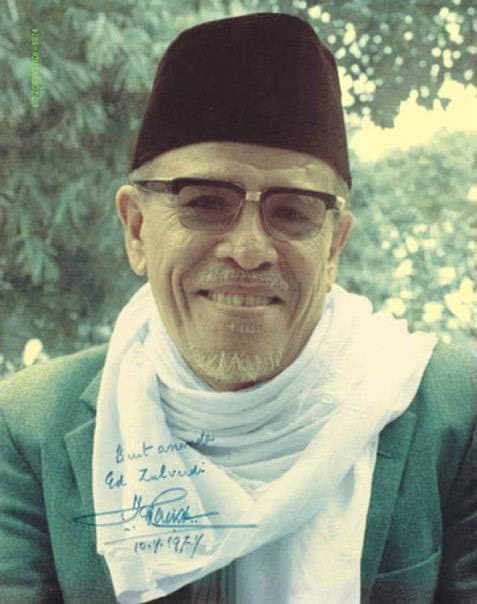
One day in 1923, a 15-year-old young man suddenly found his heart shattered. His parents, who were by no means ordinary people -- his father was renowned as a man of great learning, a distinguished scholar directly taught by Syekh Khatib al Minangkabawi, respected throughout Sumatra for co-founding the famous Sumatera Thawalib -- suddenly divorced. What teenager's heart would not be broken when their parents divorce at such a tender age?
Besides this, the young man had long wished to travel to the land of Java. He wanted to study directly under Haji Umar Said Cokroaminoto, who was also a direct teacher of Soekarno (Indonesia's first President), Musso (PKI), and Kartosuwiryo (Darul Islam). Back when he studied at Sumatera Thawalib, he rarely attended class. He preferred spending time in the library of his teacher at Thawalib: Zainuddin Labay. It was in that library that he read many compositions, tales, and poems, and it was also through that place that he read a book about Central Java, further strengthening his desire to broaden his horizons in the land of Java. So once his resolve was firm, especially after the heartbreak caused by his parents' divorce, at the still tender age of 15, he departed for the land of Java. He headed to Yogyakarta and stayed at the home of his father's younger sibling, Ja'far Amrullah.
In this new land, he began his deep engagement with Muhammadiyah and Syarikat Islam, studying under their leaders: A.R. Fakhruddin, Ki Bagus Hadikusumo, and Suryopranoto. In Bandung he met Muhammad Natsir, and of course his famous teacher Ahmad Hassan, so he also had the chance to write for Pembela Islam. In 1925, he visited Pekalongan to meet A.R. Sutan Mansyur, a Muhammadiyah leader there, who was also the brother-in-law of this now 17-year-old wanderer. It was here that the young man had many opportunities to express his ideas and thoughts through speeches. Not long after his time in Pekalongan, the young wanderer decided to return to Padang Panjang, to the land of Minangkabau with its customs.
Upon arriving in Padang Panjang, he began preaching, from one speech to another, from one village to another. Here he realized that in Java, the focus of Islam was on eradicating poverty, ignorance, and backwardness. Whereas here in Padang Panjang, the focus of Islam was on eradicating superstition, heretical innovation, and irrational beliefs.
However, a new stumbling block now faced him. Sharp criticism came from his own father: "Your speeches are useless without knowledge." Criticism also came from the community, which accused him of being a scholar "without credentials," and traditional clerics in Minangkabau criticized him for not yet fully mastering Arabic. Boom! For him, this was the second greatest pain in his 18 years of life. The first was his parents' divorce when he was 15. Upon returning from Java, he had wanted to heal his heart by preaching to his own community, only to be vilified by that very community. The reproach of "not knowing Arabic" from the clerics was something he would never forget. He felt like someone exiled from his own people.
And so at the age of 19, in 1927, still harboring pain toward the community, the traditional Minang clerics, and even his own father, without informing or asking permission from anyone, this heartbroken young man set off for the place he hoped could heal all his suffering -- suffering that had begun at a very young age. That place was Makkah al Mukarramah, the noble Mecca. Traveling aboard the ship Abeto for several weeks on the journey to and living in Mecca -- this would later become the inspiration for his first novel in Indonesian: Di Bawah Lindungan Kakbah (Under the Protection of the Kaaba).
Living in Mecca for seven months, he worked at a printing house owned by a Dutch East Indies resident who was also a brother-in-law of Syekh Khatib al Minangkabawi, named Majid Kurdi. While also serving as a correspondent for Pelita Andalas, he studied under several scholars in Mecca. At his workplace too, he had the opportunity during those seven months to read classical texts, histories, bulletins, and other works in Arabic, which he had now mastered. He wished to stay longer in Mecca, to further expand his connections with the sheikhs who held scholarly gatherings at the Grand Mosque, but God had other plans. He was brought together with Haji Agus Salim. Agus Salim's advice that their own homeland needed people like him led him to decide to return home.
But he did not return to Padang Panjang; instead he settled in Medan, where his ship had docked. In Medan, he continued his connections with Muhammad Natsir in Bandung and A.R. Fakhruddin in Yogyakarta by regularly sending his writings to Pembela Islam and Suara Muhammadiyah. In 1928, Si Sabariah was published as his first novel (written in the Minangkabau language).
For a long time his family members sent letters asking him to come home, but he never paid them any attention. His heart was too broken -- remembering Padang Panjang meant remembering his parents' divorce and his exile from his own community. Until one day, his brother-in-law, A.R. Sutan Mansyur, came to Medan to ask him to return to Padang Panjang. Remembering the great kindness A.R. Sutan Mansyur had shown him when he was very young in Pekalongan, his heart softened and he accepted his brother-in-law's invitation.
He arrived in Maninjau, his birthplace. Meanwhile, his father's house in Padang Panjang had changed, having been destroyed by an earthquake in 1926, and his impression of his father also changed. Especially after his father's astonishment upon learning that his son, who had been gone for months, had actually gone as far as Mecca to seek knowledge. A year later, the son again left his homeland, returning to Medan.
In Medan in 1936, together with Yunan Nasution, he founded the magazine Pedoman Masyarakat. Two years later, he published Di Bawah Lindungan Kakbah, a love story inspired by his journey and life in Mecca. Then came Tenggelamnya Kapal Van der Wijck, a novel compiled from stories he had previously serialized in Pedoman Masyarakat.
Only after that were other novels and books published: Tuan Direktur, Merantau ke Deli, Keadilan Ilahi, Teroesir, and so on.
Such was the brief life story of Prof Dr (HC) Hamka. The name first introduced in Pedoman Masyarakat as HAMKA. An abbreviation of his full name: Haji Abdul Malik Karim Amrullah.
Prologue
I will not speak too much about the story of Zainuddin and Hayati and their struggle to fight for their love in the film and novel Tenggelamnya Kapal Van der Wijck. Because I am sure that readers of this piece have watched the film Tenggelamnya Kapal Van der Wijck (TKVDW) in the cinema. I will only write about my impressions and the beginnings of my encounters with Hamka and his works. A film that, in my view, was very successful. Adapted from a novel of the same title by Buya Hamka, an important literary figure in Indonesian history.
So here, to answer my father's impression -- who yesterday shared his thoughts after watching the film with my mother, saying "What I remember and what impressed me is how extraordinary Hamka was in composing that novel!" -- that is also the reason I write about Hamka's extraordinarily rich life journey in this piece. A life mixed with bitterness and sorrow from his parents' divorce in his youth, compounded by having parents who were respected scholars. A life that, as Zainuddin says in the TKVDW film, "..has been washed by tears of suffering since birth," because he was exiled from his own community merely for lacking credentials and not knowing Arabic. We cannot fully appreciate either the film or the book TKVDW without understanding Hamka's own life trajectory.
I had the opportunity to watch this film three times. What made me shake my head in disbelief during my first viewing was when, at the beginning of the film, the high school students sitting next to me were exchanging bewildered glances when the screen displayed "Adapted from the mega best-selling novel by BUYA HAMKA.." They did not know the film was adapted from a novel, much less who Hamka was. I felt sorry realizing this.
My Impressions and Encounters
I first read this novel when I was in fourth or fifth grade of elementary school. At the time, I found the novel Tenggelamnya Kapal Van der Wijck in the very back room of my grandparents' house. My grandfather was a former commander in the Darul Islam/Tentara Islam Indonesia (DI/TII) rebellion movement led by Kahar Mudzakkar, which had given Soekarno considerable trouble. That back room of my grandfather's was filled with old and rather dusty books -- it could hardly be called a personal library, but that is what it was. At the time, I did not really understand the emotions between Zainuddin and Hayati -- understandably, I was still a child who did not understand love, had not yet known women since all my siblings were boys. But what I did realize then was that Buya Hamka was a great scholar and literary figure, a Muhammadiyah man, and so it was that I first came to know Buya Hamka. I also read that HAMKA was an abbreviation of Haji Abdul Malik Karim Amrullah.
My extended family is a Muhammadiyah family, in Limbung, Gowa. Limbung itself is well known as a center of Muhammadiyah in South Sulawesi. Various Muhammadiyah schools are here. From kindergarten to high school, dozens of schools. But returning to my encounters with Hamka, my mother told me that she was a subscriber to Hamka's "Dari Hati ke Hati" (From Heart to Heart) column in Panji Masyarakat (Panjimas) magazine. So I came to understand that Buya Hamka was not a "newcomer" in my family.
The third point of contact I had with Hamka was during junior high school. During junior high, I often visited an orphanage near my school. It was called Panti Asuhan Amrullah (Amrullah Orphanage), taking its name from Buya Hamka's own grandfather: Amrullah. And so those were my three initial encounters with Hamka, until the film was screened in cinemas, so heartrending, further deepening my respect for Buya Hamka.
Facts, Praise, and Criticism of the Film Tenggelamnya Kapal Van der Wijck
There are several things I wish to comment on regarding the TKVDW film and the issues people have raised about it, as well as information that viewers of the film may not know. I will also attempt to clarify things that were not in the book but were fabricated for the film.
1. Fact: Filming Location at Punaga, Takalar, and Zainuddin's Actual House
In the early part of the film, we see the beautiful seaside village of Zainuddin and the house where he lived with Mak Base, his caretaker after the deaths of his father and mother: Pandekar Sutan and Daeng Habibah. The filming location was at Punaga Beach, Punaga Village, a remote area in Takalar. Punaga is a beautiful place with its beach, cliffs, and white sand. I was surprised to learn the location was Punaga because my high school seatmate was a native of Punaga -- my first literature mentor.
In the novel itself, Hamka explains that Zainuddin lived between Kampung Baru and Kampung Mariso, south of Fort Rotterdam, where the Dutch East Indies Governor Speelman once lived and Prince Diponegoro spent his final years in exile. I can still see now the indigenous houses by the sea in that area, which are sadly being swept away by the allure of real estate developments occupied by newcomers.
The director made the right choice. It was a wise decision to film at Punaga, Takalar, rather than at the actual location.
2. Suggestion: Explaining Who Zainuddin Is in Greater Depth
The film would have achieved its full potential if only the director had explained who Zainuddin was and his sufferings in more detail. Who was Pandekar Sutan? Why was he, a Minang man, living in Makassar? Who was Mak Base really? How did Zainuddin view his childhood and sufferings? These things were insufficiently explained in the film.
If the director had explained how the title "Pandekar" (Warrior) came to be attached to Pandekar Sutan, he could then have explained why he ended up cast away in the land of Makassar and married Daeng Habibah, a Makassarese woman. In the novel, Hamka tells us that Pandekar Sutan was a man who was cast out and banished. After his parents died in his village, Batipuh, Pandekar Sutan lived with his mamak (uncle) named Datuk Mantari Labih. Readers will know the position of Ninik-Mamak in Minang custom. His uncle, as Hamka wrote, "let alone earning and adding, was only skilled at spending." Properties, several plots of rice paddies, and an heirloom gong had all been pawned off to others. Whenever Pandekar Sutan tried to pawn and utilize his own inheritance, his uncle would always object and refuse consent. Until one time his uncle said, "Rather than you use up that property, it would be better if you disappeared from this land. I would prefer that!"
The hot blood of Pandekar Sutan, who was still only a teenager at the time, surged too. He wanted to marry, to build a household, to be happy and have children, but his intentions were always opposed by his uncle, who was protected by Minang culture and custom. Then one day, a terrible quarrel erupted between Pandekar Sutan and his uncle. His uncle berated him, "If you want to marry by first using up the ancestral property, surely all the rice paddies in Minangkabau would be exhausted. This is a shameless young man, always pawning, always wanting to borrow!" Those words were like thunder at midday, spoken to Pandekar Sutan in the house, before the other uncles. Pandekar Sutan's blood boiled, and he snapped, "Uncle cannot act unjustly!" He was immediately rebuked by his uncle, "What?! You call me unjust?!" said Datuk Mantari Labih as he leapt forward, drew his kris, and lunged at Pandekar Sutan. Misfortune was to follow -- before the uncle could wield his kris, Pandekar Sutan's dagger had already been thrust into his left side, striking his heart. Datuk Mantari Labih died, and the entire household was thrown into chaos. Several people approached Pandekar Sutan, but whoever approached him fell. For the title Pandekar was earned through "decisive action," not merely bestowed.
When the Landraad (colonial court) decided the case in Padang Panjang, Pandekar Sutan confessed honestly. He was banished for 15 years, to Cilacap. Cilacap was a place of exile for Sumatrans, just as Sawahlunto was for Javanese and Bugis. From Cilacap, he was taken to the land of the Bugis. At that time, the famous Bone War was taking place.
People needed brave men, which is why Pandekar Sutan was able to set foot in the land of Makassar. In short, he had witnessed firsthand the fall of Bone, the fall of Gowa, and had also witnessed the ship Zeven Provincien fire its cannons at the port of Pare-pare. He was imprisoned there too, at the age of 20. He met Kismo, a Madurese man who was a lifelong exile. It was from Kismo that Pandekar Sutan learned Sufism. After his release from prison, he wanted to return to Minangkabau, but gave up because he understood he had no hope there -- he had been cast out and disowned. He then settled in Makassar, marrying Daeng Habibah, a Makassarese woman who actually had Minang blood because she was a descendant of Datuk ri Bandang, a Minangkabau man, one of the three dignitaries who brought Islam to the land of Makassar. And so Pandekar Sutan lived in a seaside house with Daeng Habibah, his beloved wife. Zainuddin was born, and Daeng Habibah died when Zainuddin was still an infant. As for Mak Base, she was an elderly woman from Bulukumba who then raised Zainuddin after his mother's passing. It is Mak Base whom we see in the film. Zainuddin, who was left with only his father, knew love and affection from Mak Base alone. His definition of love was something he had only ever received from Mak Base. If only the director had explained this more in the film, surely we would have been moved and understood why Zainuddin could become so madly in love with Hayati. Of course! Hayati was the first person to give her pure love to Zainuddin, and Zainuddin, after Mak Base's passing, knew only one love: from Hayati alone. Likewise Hayati. She, who had been sheltered and kept from contact with men by her uncle, knew love from only one person: Zainuddin. But which love is more agonizing -- when two people who already know they love each other, each having only ever known one love, are suddenly torn apart merely because of customary differences, because Zainuddin's mother was not Minang; merely because of money, because Zainuddin was an orphan child whose parents had died in Makassar and therefore had no wealth; and tragically the pure-hearted young man was abandoned and rejected by Hayati and her family because there was another young man who was wealthier, of higher birth, more cultured, of better lineage, and more established, named Azis! And so Zainuddin's pure and sincere love was abandoned, merely because of the lure of money and reasons of birth and lineage. How tragic.
Well, generally speaking, I am understanding of the director who worked very hard. The film's duration is nearly three hours. Even without such depiction as above.
3. Fact: TEROESIR
In both the film and the book, it is told that after Zainuddin was expelled from Batipuh, he met Muluk and moved to Batavia (and subsequently to Surabaya). He published a serial story in a newspaper, using the pseudonym "Z." His newspaper serial became a huge hit, and he eventually published a novel compiled from those serial stories. The title of that book was TEROESIR (The Exiled). And the fact is... in real life, Hamka also published a book with the title TEROESIR.
4. Criticism: The Dutch-Style Party at Zainuddin's House
After Zainuddin became successful and changed his name to Shabir, at one point he organized a tonil (stage play) of his novel titled Teroesir. He served as the regisseur (director). After the event, a dinner party was held at Zainuddin's house. However, my criticism is the addition of a dance party complete with Dutch-style music. This part does not exist in the novel and was never written by Hamka. It gives the impression that Zainuddin was no longer a religious person after becoming wealthy and rich. Moreover, the music used had effects added that I cannot name but certainly did not exist in that era.
5. Criticism and Fact: Hayati's Revealing Clothing
Many have criticized Hayati's revealing clothing. The most common complaint has been "Minang girls don't dress like that." But what could the director do -- that is indeed what Hamka wrote in his novel. The scene in the film where Hayati for the first time wears clothing that reveals her figure was indeed written by Hamka in his novel. However, in the novel, Hayati after marrying Azis states that she is uncomfortable with such clothing, but Azis insists. This part was not shown in the film. It gives the impression that Hayati happily wears such revealing clothing and that Zainuddin does not mind. Although in the film we do see Zainuddin sweating, his face full of disappointment, when he sees Hayati and her new appearance for the first time at the fair and horse races.
In the novel, after the meeting at the fair and horse races, Zainuddin then sends a letter to Hayati. Forgive me, Hayati, if I speak frankly, so that my heart bears not even an atom's weight of sin toward you. True love, my dear, is not hypocritical -- smooth on the outside, cutting within. I will speak my heart's feelings honestly, even if it means you would kill me for it; I would be blessed if by your hand.
Hayati! What did I see yesterday? Why have your clothes changed, your style changed? Where is your baju kurung? Are you not a village woman? I do not criticize the form of modern clothing; what I criticize is the way that has gone overboard, wrapping excess in the name of "fashion." Yesterday, you wore the sheerest of blouses, nearly half your chest visible, the sleeves cut tight, and you wore that outfit out among the crowd.
I believe that this is not the true Hayati's wish. Hayati is merely following the desires of modern women. They say that is progress, but progress is far from that. Is the purpose of progress merely a change of clothing to such an extent, Hayati?
Hayati, my life! Wear your original clothing again, put on your village dress. Forgive me, Hayati, but you are very beautiful, and your beauty is not aided by clothing but is God's creation from the moment you were born.
Do not be angry, Hayati. You are only for me alone, not for others. Let others call you a village woman, unfamiliar with modern fashion; you are Hayati... You are only for me alone.
Zainuddin
6. Fact: Zainuddin Kisses the Dead Hayati
The next thing widely criticized is why Zainuddin kisses Hayati's forehead, cheeks, and even lips. The fact is, in his novel, Hamka did indeed write it so. In my view, it was simply an outpouring of emotion. There was no intention on Zainuddin's part to touch the skin of a woman who was not his wife, just as he had previously been conscious that Hayati's henna-stained hands meant she was not his to touch. She already belonged to someone else.
But let us observe how Hamka wrote it in his novel. The others were still standing near the other bed, standing respectfully around the corpse as if offering a farewell salute. The room fell into silence.
Not long after, those people left one by one with reverence and contemplation; only Zainuddin and Muluk remained. Zainuddin could not restrain his heart any longer. He approached the head of the corpse, stroked her coiled hair, his tears moistening the cheeks of the deceased. He prostrated himself like a servant about to kiss the hand of his master for some time, not moving, not looking left or right. Then he stroked the forehead of the corpse once more, and kissed the lips that had turned pale -- that which he was never fortunate enough to obtain in life, he could only take after she had died. After that he fell unconscious.
7. Fact: Hayati Offers Her Hair
In the film, when Zainuddin had been expelled by Hayati's uncles from Batipuh, before he left for Padang Panjang after dawn, he found Hayati standing at the end of the road. At the end of their parting, Hayati gave Zainuddin a piece of her headscarf as a keepsake. I think this was good work by the director, without bothering to slavishly copy the novel. In the novel, Hamka describes that at her parting with Zainuddin, Hayati removed her headscarf and then pulled out several strands of her hair to give to Zainuddin. Imagine how difficult that scene would have been to film if they had to replicate the hair-pulling scene.
8. Fact: Hamka Visited Makassar
The performance of Herjunot Ali as Zainuddin in this film deserves appreciation, in my opinion: his accent, his language, his choice of words, and his gaze could well represent Zainuddin, the Makassarese character portrayed by Hamka in his novel. However, many might wonder: where did Hamka conceive this important character? Where did Hamka study the temperament and nature of the Makassarese people?
The fact is, Buya Hamka did indeed visit Makassar and stay here for some time. That was in 1932, six years before the novel Tenggelamnya Kapal Van der Wijck was published in 1938. At that time, Buya Hamka was dispatched by Muhammadiyah's central leadership to inspire the spirit of young people, administrators, cadres, and sympathizers of Muhammadiyah in South Sulawesi ahead of the 1932 Muhammadiyah Congress held in Makassar. So Buya Hamka stayed in Makassar for some time. When you read the novel Tenggelamnya Kapal Van der Wijck, you will understand why in the very first chapter Buya Hamka so vividly describes the landscape and layout of Zainuddin's house and the city of Makassar: he depicts Zainuddin's house between Kampung Baru and Kampung Mariso; the sea in front of Zainuddin's house; Fort Rotterdam not far behind it; then Karebosi Field and its mystical tales; and also Mount Bawakaraeng, Mount Lompo Battang, and Bantimurung in Maros. All of it depicted enchantingly by Hamka, right in the first chapter!
And so we come to understand why Hamka depicted Zainuddin and Makassar in this novel in a way that satisfies native Makassarese, like myself.
9. Fact: Bang Muluk
In the film, Bang Muluk's age is not specified, although in my opinion it is quite important. In the novel, Hamka explains that Bang Muluk was a parewa (rogue) who was older than Zainuddin. Although he was a rogue, he had tasted his share of life's ups and downs. As a result, despite being a rogue, he became a wise, loyal, and cautious man. If Bang Muluk were depicted this way, and then he motivates Zainuddin in his room upon learning that Hayati's hands were stained with henna -- a sign she already belonged to another -- the audience would understand and not carelessly accuse, "Bang Muluk changed so suddenly!" Another thing is that Bang Muluk always addresses Zainuddin as "Engku" in the film. In the novel, Hamka portrays Bang Muluk as always addressing Zainuddin as "Guru" (Teacher), always. But that was the director's own creative decision regarding Bang Muluk. Besides, in the film, Bang Muluk adds his own color, and if we imagine the film without this version of Bang Muluk, it would be bland indeed.
10. Fact: The Sinking of the Van der Wijck
Hamka closes the love story of Zainuddin and Hayati with an event that became the title of this novel: Tenggelamnya Kapal Van der Wijck (The Sinking of the Van der Wijck). However, this event was not fictional but real. The Van der Wijck, a K.P.M. ship built by Feyenoord in Rotterdam, truly sank after sailing into the waters of Brondong near Tuban. The fishermen of Brondong rendered great service in rescuing victims of this sinking ship. For this reason, the Dutch government erected the Van der Wijck Monument in Brondong, in honor of the fishermen who rescued the disaster's victims.
11. Fact: Zainuddin and Hamka Smoked
I am grateful to the director of the TKVDW film for portraying a non-smoking Zainuddin. Although Hamka wrote several scenes of Zainuddin smoking. In fact, Hamka himself once smoked. I read about this in a book written by his son, Irfan Hamka. However, people's perceptions and understanding of smoking in the present day versus in Buya Hamka's era are clearly different. So the director's decision to portray Zainuddin as a non-smoker was correct, because society's perception and knowledge of smoking has changed in the present day.
Epilogue
Tenggelamnya Kapal Van der Wijck is a novel of tremendous influence in the history of Indonesian literature. This novel was once required reading for schoolchildren during the New Order era, though sadly it is now given less attention. Not only in Indonesia -- even in Malaysia and Singapore, the TKVDW novel was once required reading in literature classes at schools.
After a long time without engaging with Hamka and his works, last during junior high school, I am grateful this novel was adapted into a film, and a successful one at that! Thus my respect for Hamka has only grown. Prof Dr Haji Abdul Malik Karim Amrullah. A statesman, literary figure, cultural figure, philosopher, and I could also call him a Sufi or mystic.
If we observe, Hamka's fictional stories are largely inspired by his own life story. These novels can illustrate this: Di Bawah Lindungan Kakbah, Tenggelamnya Kapal Van der Wijck, Merantau ke Deli, Teroesir, and others. These novels are laden with a consistent theme: suffering at a young age, being exiled from one's community, the agony of fate not being on one's side, being abandoned by love, and the like -- things that in my view were inspired by Hamka's own life. I need not explain further, as I have briefly outlined his life journey at the beginning of this piece.
Hamka himself wrote in the preface to the novel Tenggelamnya Kapal Van der Wijck, written in the foreword to the fifth printing: At the age of 31 (1938), when young blood flows quickly within and imagination and sentiment still fill the soul, it was at that time that the "inspiration" for Tenggelamnya Kapal Van der Wijck first took shape and was published serially in the magazine I led, Pedoman Masyarakat. After that it was published as a book by Brother M. Tarkawi (second printing), an industrious young man who published valuable books. Not long after its release, it was sold out. Many young people said, "It is as if you are telling my own story." Others said, "Perhaps it is yourself that you are telling!"
In closing, I wish I could explain more about the man I now define as one of the most influential writers in my life: Hamka. I wish I could explain how he was arrested by the Soekarno regime on charges of plotting to assassinate the president. I wish I could explain how he was imprisoned for two years (1964-1966) by Soekarno, yet from within that prison emerged one of his most influential works: Tafsir al Azhar. I wish I could tell how he received an Honorary Doctorate (Dr. HC) from Al-Azhar University in Egypt. I wish I could tell how he was a rare person in Indonesia, a singular figure because he was a scholar, a literary man, a cultural figure, a philosopher, and I could also call him a Sufi. But alas, knowledge must be absorbed little by little, not all at once.
These are my impressions and encounters with Prof Dr Haji Abdul Malik Karim Amrullah and Tenggelamnya Kapal Van der Wijck.
May it be beneficial!
Muhammad Ihsan Harahap, Bontokaddopepe, January 29, 2014, written while rain fell on the city of Makassar
For: the one who has been waiting since this morning.